
SEO Is Changing: Is Your Business Ready for AI Search in 2026?
Being on the first page of Google used to be the ultimate goal for two decades now. The goalpost has changed in 2026. AI Overviews, ChatGPT, Perplexity, Gemini, YouTube, Reddit discussions, Google Maps, and many others belong to the various platforms that define search. The companies that take search not as one page but an ecosystem are winning the awareness race now.
This is what’s really changing along with some things you may be doing this year.
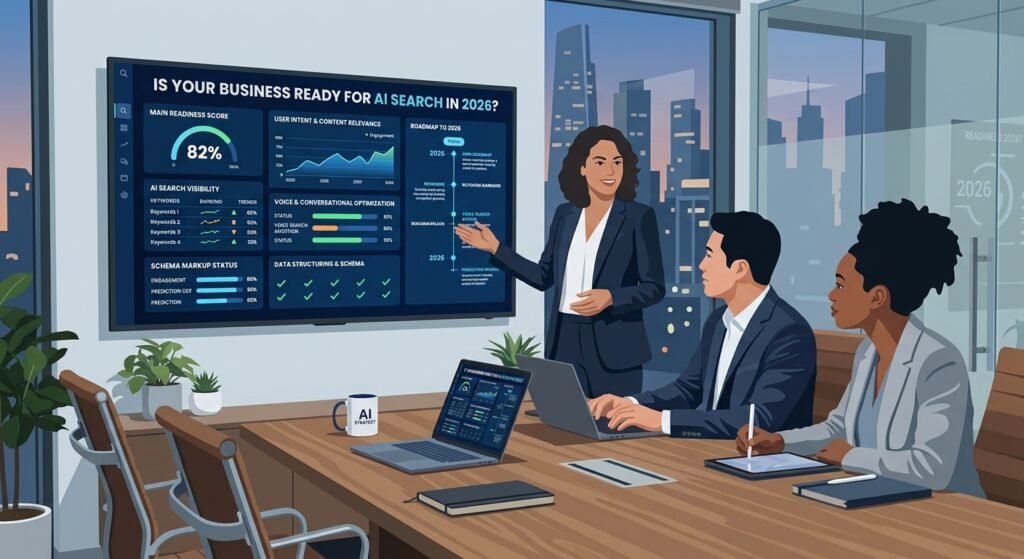
SEO Is Splitting into Various Channels,
Rather Than Dying The most popular claim over the last two years is that “SEO is dead.” But it’s not. It’s simply the case that the idea that a Google search will result in the ten blue links is no longer true. Search engines function as answer engines, giving direct answers to queries without even having to click. This means that the new goal is replacing the old goal of being ranked #1 and getting that click. The new goal is to become a source that AI models will be able to cite, recommend, and summarize.
Retrieval augmented generation (RAG) is the technology on which most AI responses are based, such as Google AI Overviews, ChatGPT browsing, and Perplexity citations. The same old indexed, crawlable web pages that traditional SEO techniques have always targeted remain at the heart of the matter, and they are selected and packaged into a response.
Trend 1: Visibility is growing while click-throughs are declining
The number of click-throughs from the traditional first search result is being quantitatively reduced by the introduction of AI Overviews and AI Responses; according to the estimates made by the industry, it decreases by roughly a third for questions answered by the AI Overview. On the other hand, due to the ease of asking more, and more specific questions enabled by AI, search volume and impression counts are growing as well.
The valuable takeaway is that you must not assess the SEO performance of your website only based on the number of clicks anymore. Even without any immediate click-through, the fact of being mentioned or referenced in the AI Overview or AI Response means that your website is actually engaged in marketing activities, such as building brand awareness and trust and affecting customer decisions. Measuring the number of brand mentions and references in AI Responses is one of the ways to do that.
Trend 2: New SEO Competencies – GEO and AEO
For 2026, marketing professionals have new SEO terms such as Generative Engine Optimization (GEO) and Answer Engine Optimization (AEO), which they may use to enhance the material and ensure that the artificial intelligence system quotes it, promotes it, and does not just rank it. This is an addition to SEO and not its replacement. The basics – craw lability, speed, good structure, and usefulness – are still essential. Creating content that can be easily extracted from an AI model as the exact answer is new.
Useful Actions:
Answer the core questions in the first two or three phrases of the section; do not hide the question under an extensive introduction.
Have the headers precise and relevant to how people ask the questions.
Instead of using vague generalizations, support statements with specific facts or your experience.
Trend #3: E-E-A-T Is More Important Then Ever
Although E-E-A-T (Experience, Expertise, Authoritativeness, and Trustworthiness) has always been a concept developed by Google. In 2026, it will be the main criteria by
Which AI will judge whether It is okay to cite some source. Generative models prefer
Content that gives.A glimpse of,First-hand experience (real photos, an author with credentials, original information) because quoting a source becomes a kind of
Endorsement of it. When it comes to a business blog, it means: do not post everything.That can Write about companies in your industry; show your own product, its results and customers; and provide the real name of the author along with the bio.
Trend 4: It Is Time to Use Structured Data
Whereas Schema markup and structured data had been around for some time,
It has become interesting again.because they allow AI tools to easily understand your content, such as product prices, reviews, FAQs, business information, and availability. A detailed product schema (product availability, shipping, return policy) is fast becoming a standard requirement for participating in AI-guided shopping experiences, especially in e-commerce, where more and more business-to-business and business-to-consumer customers claim to be equally trusting of generative AI suggestions as those from traditional searches.
Trend 5: Generic Keywords Have Become Less Important than Brand Signals
Just like a consumer who will research on three websites before purchasing, an AI search engine will also cross-check from multiple sources before recognizing a brand. Consequently, regular mentions of your brand on your website, reviews, social media, and trade publications now carry SEO weight. In relation, branded searches or direct searches for your brand name are increasingly more important than generic keyword traffic because they denote intention and reliability, which is just what AI engines require.
Trend 6: Multi-Platform Search
In today’s world, individuals don’t just go to Google. They seek answers from ChatGPT for choice comparisons, instructions via YouTube, feedback from Reddit, and Maps for locating something in their locality. By 2026, “being discovered” will mean that you are available on all these platforms and not only a website. Because AI tools increasingly rely on transcripts and descriptions to formulate answers, video content is increasingly playing an important part in AI citations.
Trend 7: Hyper Localization of Local Search
AI-powered search is becoming more skillful in identifying the closest and most relevant supplier and not the most famous in the whole city. This brings down the competitive zone for small and regional businesses to a few blocks and not an entire city. This